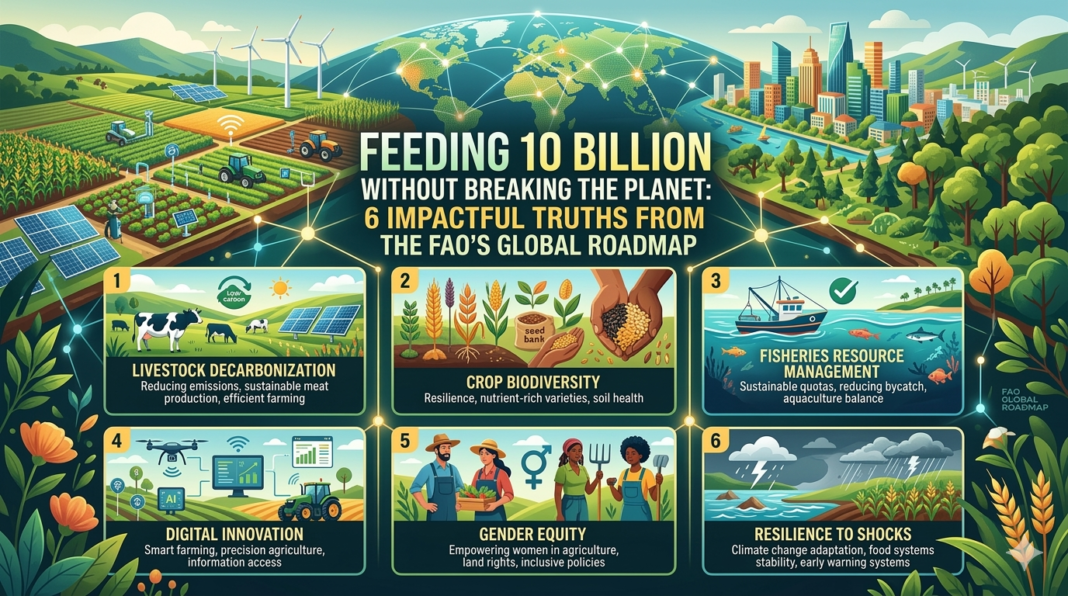

1. Sustainable Food Systems and the 2030 Dilemma

Sustainable food systems now sit at the heart of a central global tension: a perceived trade-off between the survival of the hungry and the survival of the Holocene. Transforming climate-smart farming and food technology has never been more urgent — while we currently produce enough calories to feed the world, our distribution and dietary systems are failing. In 2022, 738.9 million people faced chronic hunger, and a staggering 3.1 billion — nearly 40% of humanity — could not afford a healthy diet.”
The urgency is not merely ethical; it is temporal. The FAOprojects that, without a radical shift, 590.3 million people will still be suffering from hunger in 2030. Furthermore, we are currently oscillating between “production” to meet immediate needs and “protection” of a 1.5°C climate threshold according to the WHO. Therefore, to move forward, we must stop viewing these as competing interests and start viewing agrifood transformation as the single most powerful engine for global stability and climate resilience.
2. Sustainable Food Systems: Synergies Over Sacrifice
The narrative that we must choose between a full plate and a cool planet is a myth that fuels the “Four Ds” of inaction: Denial, Division, Distraction, and Doomism.
While agrifood systems are responsible for 30% of anthropogenic greenhouse gas (GHG) emissions, they are not merely “carbon villains.” Unlike the energy sector, which focuses on reduction, the agrifood sector holds a unique dual power: it can simultaneously mitigate emissions and act as a massive carbon sink through sequestration. By aligning this transformation with global climate finance, we can unlock the sector’s potential to move from a net emitter to a net carbon sink of -1.5 Gt CO2eq per year by 2050. Transforming the system isn’t an obstacle to the Paris Agreement; it is the prerequisite for its success.
Agrifood systems face a dilemma: producing more now to address immediate needs, while endangering future food security and nutrition, or curbing production to reduce emissions. This perceived trade-off has led to inaction and emboldens climate action skeptics.
3. The Livestock Paradox: The Front Line of the Nexus
The livestock sector is the ultimate proving ground for the agrifood-climate nexus. It contributes 26% of all agrifood emissions, with beef and cattle alone responsible for 70% of that footprint. However, livestock also supports the livelihoods of 1.7 billion of the world’s poor.
Sustainable food systems demand a high-wire balancing act:
- Total Factor Productivity (TFP): We must achieve a 1.7% annual growth in livestock productivity—a rate that must double the performance of the last decade.
- Emission Reductions: Simultaneously, we must reduce emissions from livestock production by 3% annually.
How? Through strategic intensification. By focusing on improved genetics and feed efficiency, we can reduce the land and water footprint per unit of protein. This technological path is essential not only for the climate but also for global health; it prevents the overuse of antibiotics and reduces the risk of zoonotic disease outbreaks in densely populated areas.
4. Sustainable Food Systems and Your Diet
“Healthy Diets for All” is often discussed as a public health goal, but the FAO Roadmap frames it as a primary vehicle for climate mitigation. For a diet to be truly “healthy” and sustainable, it must adhere to four universal principles: adequacy, balance, diversity, and moderation.
The strategy relies on a concept of Global Rebalancing. This idea is not a mandate for global veganism, but a move toward convergence. High-consumption regions must shift toward resource-efficient choices to relieve stress on the planetary boundaries. Meanwhile, low-income regions must gain greater access to nutrient-dense foods (such as aquatic foods and dairy) to eliminate the cognitive and physical toll of undernourishment. By tracking indicators like affordability and actual consumption patterns, we move the needle from “hunger” to “nourished resilience.”
5. The Data Dividend: A 3,200% ROI
For sustainable food systems, perhaps the most striking FAO statistic is the economic power of information: for every 1unit invested in strengthening data systems in low- and middle-income countries, the return is 32 units.
Sustainable food systems also depend on trusted data. Digital agriculture tools, such as remote sensing and the FAO’s WaPOR (Water Productivity through Open access of Remotely sensed derived data), are the catalysts for this “Data Dividend.” They provide the transparency needed to prevent greenwashing and ensure climate finance reaches the most impactful projects.
Critical data priorities include:
- Farm-Level Emission Measurement: Moving away from “global averages” to local, actionable metrics.
- Sex-Disaggregated Data: Quantifying the specific climate risks faced by women to tailor interventions.
- Early Warning Systems (EWS): Utilizing Big Data to trigger anticipatory actions before a drought becomes a famine.
6. The Gender Resilience Factor: Predictor of Stability
Climate change is not gender-neutral. Female-headed households lose 8% more of their income to heat stress and 3% more to floods than male-headed households. Yet, the “surprise” within the data is that empowered women are the strongest predictors of a household’s climate resilience.
In particular, when women have equal access to land rights, education, and finance, the entire family’s ability to withstand shocks increases. A “Just Transition” is not just about fairness; it is about economic pragmatism. To ignore the vulnerability of women and Indigenous Peoples is to ignore the primary stewards of the planet’s biodiversity.
7. Food Loss Across Sustainable Food Systems
The most illogical feature of our current system is that we lose or waste nearly a third of all food produced.
- Food Loss (13.2%): Occurs post-harvest in the supply chain due to poor storage and cooling.
- Food Waste (17%): Occurs at the retail and consumer level.
Combined, this accounts for 8% of total agrifood emissions. The solution lies in the Circular Bioeconomy. By closing the loop—converting non-consumable food fractions into bioenergy or high-quality animal feed—we treat “waste” as a resource. It is the lowest-hanging fruit in the climate fight: reducing waste by 50% at the retail/consumer level by 2030 is a non-negotiable milestone.
8. Conclusion: Harvesting What We Sow
The “Road to 2050” is not a single leap, but a series of staggered innovation waves:
- 2025: Achieve Zero Net Deforestation globally.
- 2030: Eliminate chronic hunger and reduce gross GHG emissions by 25%.
- 2035: Reach CO2 neutrality in agrifood systems (with only non-CO2 gases remaining).
- 2050: Complete the transition to a net carbon sink.
The challenge is monumental, but the roadmap proves it is technically and economically viable. However, it leaves us with a stark choice.
The Final Ponderable: If we fail to meet these ambitious productivity and efficiency targets, we will be forced into an impossible corner. Since sacrificing the food security of the most vulnerable is ethically impossible, the transformation of sustainable food systems becomes a shared responsibility. Are we — the world’s high-consumption consumers — prepared to make the radical, immediate lifestyle shifts required to fill the gap? We will harvest exactly what we choose to sow today.
AGTECH BRIEFING · A FUTURECENTRAL BRIEFING
Get practical agriculture intelligence in your inbox.
Focused analysis for people building, financing, and managing agriculture and food systems.
Free to subscribe. Confirm your email after signing up. Unsubscribe at any time.

