

AI talent in agribusiness links farm knowledge with data and sound decisions. Hiring is one part of that job. The wider task is to build teams that can use AI in daily workflows.
Many enterprises hire data specialists and expect quick gains. Yet those specialists may know little about crop cycles, buying, storage, or rural sales. Farm and business teams face the reverse gap. They know the operations but may find it hard to frame a problem for an AI team.
So leaders need people who can cross that gap. They also need clear roles, useful data, and time to learn.
Why AI Talent in Agribusiness Is Different
Agribusiness spans farms, plants, stores, markets, and lenders. Data can change with the crop, place, season, and source. A model that works in one region may fail in another.
For example, take a forecast for fresh produce. A data specialist can improve the forecast. The buyer knows which crops can replace each other. Meanwhile, a logistics lead knows where trucks may be late. Quality staff know how delay cuts shelf life.
Each view matters. Therefore, a useful AI workforce needs five kinds of capability:
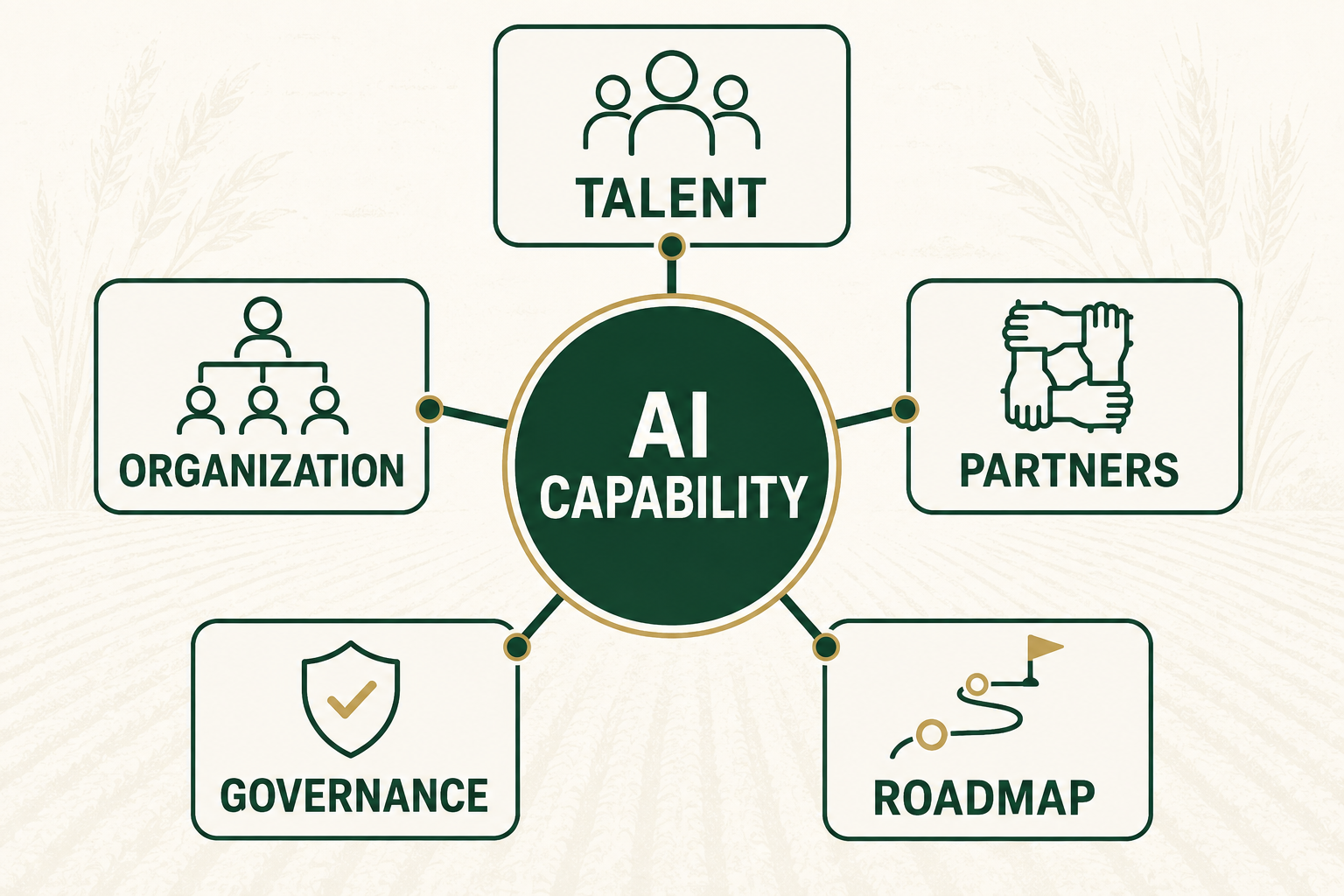
- **Farm and market specialists** who know crops, buyers, suppliers, and rules.
- **Data specialists** who keep records clean, safe, and fit for use.
- **AI specialists** who build, test, and watch models.
- **Work leads** who fit the tool into a real task.
- **Risk leads** who set checks and decide who acts when something goes wrong.
The mix will change with each use case. Still, every live system needs a named owner outside the technical workforce.
Decide What to Build, Hire, or Buy
Leaders first need to decide where each capability will come from. Most enterprises will build some capabilities, hire for some roles, and obtain outside support from a partner.
Build capabilities tied to the enterprise
Train employees when the capability rests on knowledge unique to the enterprise. That may include crop checks, buying rules, supplier ties, or years of local sales data.
Internal training takes time. However, it keeps key lessons inside the enterprise. Staff can teach peers and use what they learn on the next project.
Hire people who can form the core team
Outside hires can add speed when the enterprise lacks an AI or product lead. Yet a new hire needs access to employees, data, and senior leaders.
Give that person a clear responsibility. For example, the first AI lead might set basic guidelines, coach small groups, and guide projects from a test into daily operations.
Use partners for speed and rare capabilities
Partners can supply cloud tools, models, and specialist help. As a result, a enterprise may start faster than it could on its own.
The enterprise must still know enough to test the operations. It must guard its data, question weak results, and switch vendors when needed. The duty for each business decision stays with the enterprise.
In practice, the three routes often operations in order. A enterprise may use a partner to begin, hire a small core team, and train its own employees as it learns. This path supports a wider AI strategy for agribusiness and helps stop pilots from fading away.
How to Organize AI Talent in Agribusiness
An enterprise can place its AI employees in one main department. This makes it easier to share applications and set common guidelines. However, the group may lose touch with field needs.
Another option is to place AI employees inside units such as buying, finance, supply chains, or sales. These employees stay close to users. Yet each unit may acquire its own tools and repeat the same operations.
A mixed model joins both ideas. A small central group owns shared applications, data guidelines, employee development, and risk checks. Employees inside each unit own adoption, workflow design, and results.
For many large enterprises, this mixed model is a good fit. Even so, each role must be clear. The central group should guide operations without slowing them down. Meanwhile, unit groups should move fast while using shared guidelines.
Grow AI Talent in Agribusiness from Within
The hardest role to fill may be the person who links a business need to an AI design. This person does not need to be the best coder.
A buyer might frame a demand problem and test the result. A crop specialist may know when a model could fail. Likewise, a data analyst may bring time spent with field teams.
Firms can grow these bridge roles through operations:
- Pick a decision that employees make often.
- Name the person who owns that decision.
- Pair a field or business specialist with an AI specialist.
- Map the current task, data, risks, and result.
- Test a small tool and review its errors with users.
- Save the lessons so another team can use them.
This method builds judgment through real operations. In addition, it gives both sides a shared language.
India has a wider base for such learning. The Government of India’s IndiaAI Mission includes a FutureSkills pillar for AI courses and capability programs. Firms can draw on that base. However, they must add their own training on crops, value chains, rural groups, and food systems.
Readers who want a basic guide can start with our article on machine learning and artificial intelligence in agriculture.
Give Skilled People Reasons to Stay
AI talent in agribusiness is easier to retain when skilled people can see the value of their work and a path for growth.
Training without a plan to keep employees can help rivals more than the enterprise. Pay matters, but good operations and room to grow matter too.
AI specialists want sound data, good tools, and projects that reach live use. Field specialists want respect for what they know. Both groups need a career path that rewards mixed capabilities.
Therefore, leaders should ask:
- Are teams solving problems with clear value?
- Can employees move across roles and learn the business?
- Do they have time to learn new capabilities?
- Does the enterprise reward safe, useful operations as well as speed?
Professionals stay when they see their operations shape a real decision. By contrast, they lose faith when each pilot ends with a slide deck.
Prepare the Wider Workforce
AI will change operations for buyers, field employees, plant teams, analysts, account leads, and managers. So the talent plan must cover more than specialists.
Some employees need basic AI capabilities so they can use tools with care. Others need training for one task. A smaller group must know how to build, test, or watch a system.
Managers should explain what each tool will do. They should also state its limits and show where people still decide. As a result, employees can raise doubts before a weak output causes harm.
Frontline feedback is valuable. For instance, field groups often spot bad data, poor alerts, and local gaps before a central group does. Their feedback gives the AI team new facts for the next test.
Use a Three-Stage AI Talent Roadmap in Agribusiness
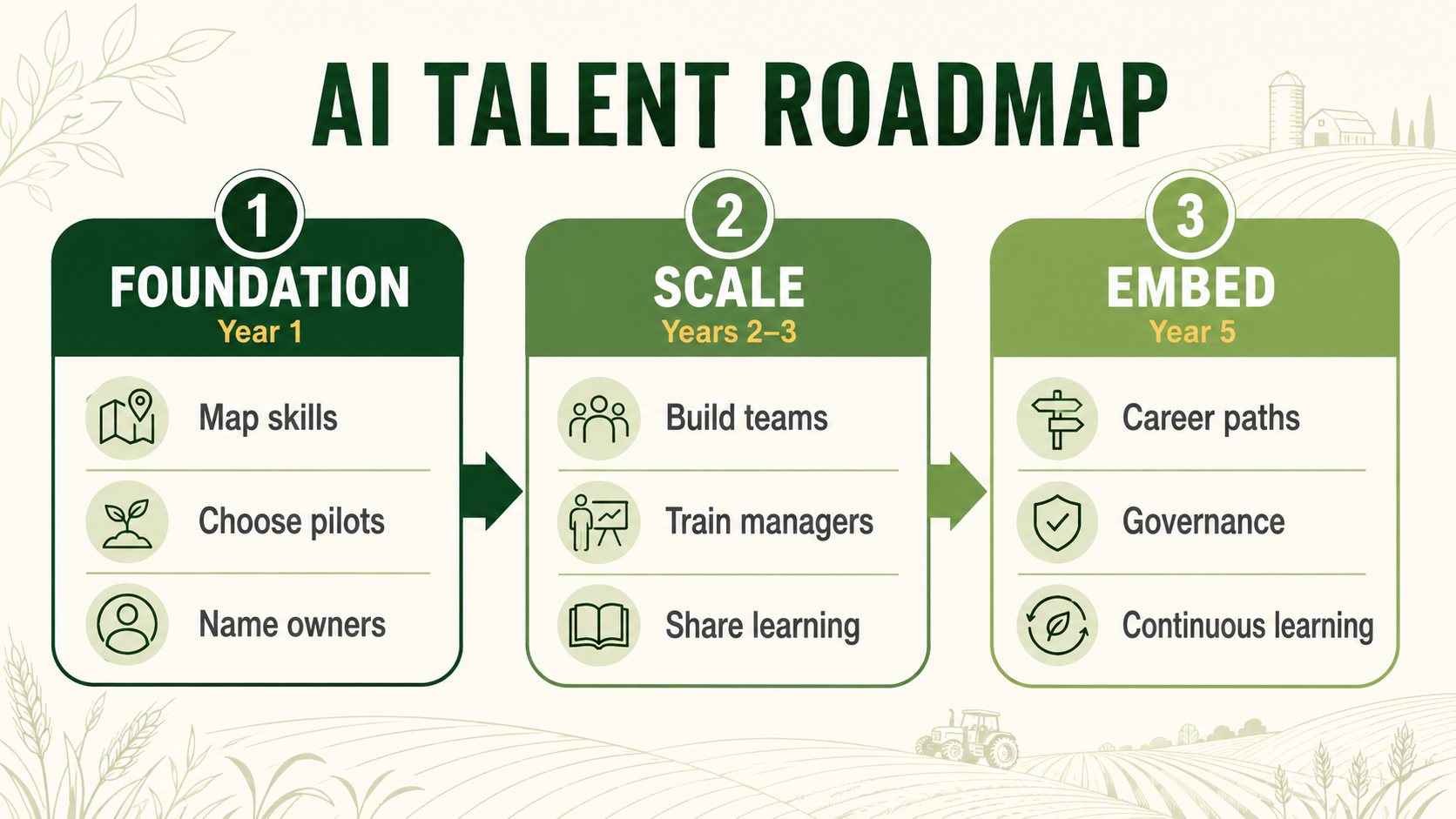
During the next year
Choose two or three key business decisions. Name an owner for each one. Then list the farm, data, AI, operations, and risk capabilities needed. Fill urgent gaps through training, hiring, or partners.
During the next three years
Create a model that teams can use again. Grow bridge roles, shared data rules, common test methods, and clear career paths. Then move useful tools into daily workflows.
Set the five-year direction
Decide which capabilities and systems the enterprise must own. These may include its own data, decision tools, local-language advice, or supply-chain insight. Near-term spending should lead toward that goal.
The roadmap must last through budget and employees changes. Otherwise, each new project starts with a new vendor and the same old gaps.
Five Questions for Leaders
Before approving the next AI budget, ask:
- Which capabilities should we build, hire, or acquire?
- Where will the team sit, and who owns the result?
- How will field and AI specialists operations together?
- Who will test the tool and handle risk?
- What should the enterprise be able to do in one, three, and five years?
A missing answer need not stop a small test. However, it will make long-term gains less likely.
Why AI Talent in Agribusiness Creates an Edge
Rivals can acquire the same software. They can hire from the same labor pool and use the same cloud enterprises. Years of shared learning are much harder to copy.
That shared knowledge is the real edge. AI talent in agribusiness creates value when people improve decisions, fix daily workflows, learn from errors, and share those lessons across the enterprise.
Leaders can start with one key decision. Map the five capabilities needed to improve it. The gaps will show whether to build, hire, obtain outside support, or use all three.
—
AGTECH BRIEFING · A FUTURECENTRAL BRIEFING
Get practical agriculture intelligence in your inbox.
Focused analysis for people building, financing, and managing agriculture and food systems.
Free to subscribe. Confirm your email after signing up. Unsubscribe at any time.

