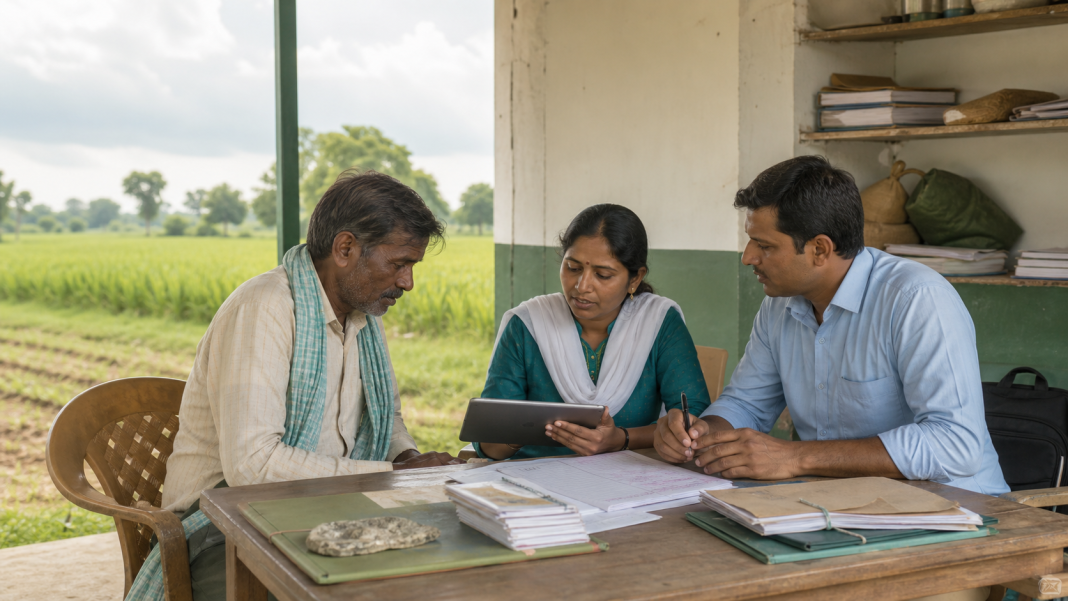

Farm finance gaps often appear as missing records. A tenant may lack a clear land title. One Farmer Producer Organization (FPO) may have sales but little credit history. A farm firm may need a larger loan than microfinance can offer. Yet it may still be too small for a bank’s corporate lending desk.
These borrowers aren’t necessarily weak businesses. Instead, conventional finance may struggle to read how they earn, trade, and repay.
Agri fintech can help by changing the evidence a lender uses and the channel through which finance reaches the customer. However, digitizing a loan form won’t solve the problem. A useful model must close one or more structural gaps in agricultural finance.
This article presents five tests for judging whether it does.
A Farm Loan in Practice
Think of a farmer who grows onions on leased land. He needs cash for seed, labor, and water. The crop buyer will pay only after the harvest. A normal loan may ask for land papers and fixed monthly dues. Neither fits his case well.
Now place the farmer in an active FPO. The group buys inputs, weighs each crop, and sells in bulk. It can show what the farmer bought, grew, and sold. A lender can use that trade trail to size the loan and set a due date after harvest.
The FPO can also help with the last mile. It knows the farmer and has a local desk. Thus, the lender need not build a branch or send staff for each small loan.
Yet this plan can still fail. The crop data may be wrong. A fall in price may leave too little cash to pay. The FPO may not explain the fee, or the lender may use harsh steps when rain harms the crop.
This short case holds all five gaps. Land papers point to the collateral gap. The trade trail deals with data. The FPO cuts the cost of reach. Crop and price risk shape the loan terms. Clear fees and fair care build trust.
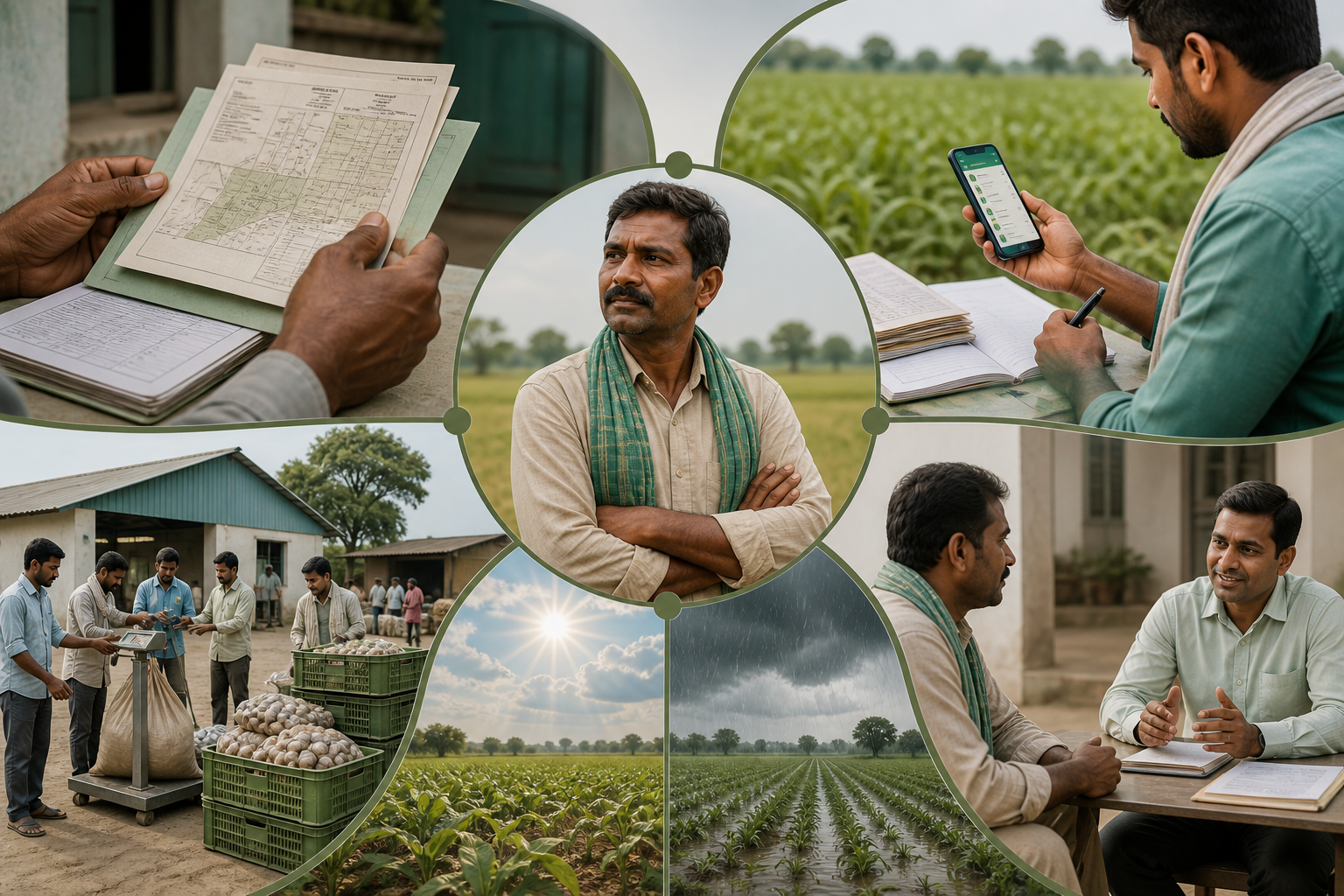
Why Farm Finance Gaps Persist
Farm income follows crop and market cycles. Costs arrive before sowing, while much of the revenue arrives after harvest. Weather, pests, and price movements can change the outcome along the way.
Meanwhile, banks must control risk and the cost of serving each account. Small, remote, and seasonal loans can be expensive to assess through branch-led methods. Standard credit models may also depend on records that many agricultural customers don’t produce.
India has a dense institutional system for farm finance. It includes commercial banks, regional rural banks, cooperative banks, microfinance institutions, non-banking financial companies, FPOs, and the National Bank for Agriculture and Rural Development (NABARD). Still, a dense system can leave spaces between institutions.
Agri fintech works inside those spaces. The first article in this series explains what agri fintech means and how its ecosystem works. The five tests below help you assess a specific product or venture.
1. Farm Finance Gaps: Collateral
Agricultural lenders have traditionally relied on land, a standing crop, or stored produce as security. Each option excludes some customers.
Land-based lending works best when ownership records are clear. However, tenants, sharecroppers, and cultivators on informally held land may not meet that test. A standing crop can’t support credit before sowing. Likewise, a warehouse receipt helps only after produce enters an approved warehouse.
Agri fintech can offer other forms of proof. For example, a lender may review orders, deliveries, crop cycles, buyers, or cash flow through an FPO. The lender still takes risk. Trade records can support the loan even when property can’t.
The practical question is simple: has the product replaced collateral, or has it only digitized the paperwork around the same collateral rule?
A model scores well when customers without traditional security can qualify through credible cash-flow or value-chain evidence. It scores poorly when the app looks new but the eligibility test remains unchanged.
2. The Data Gap
A small farmer may leave a thin formal record. The bank account may show few transactions. Goods and Services Tax returns may not apply. A credit bureau may have little to report because the customer has rarely used formal credit.
Digital consent systems can make existing records easier to access. Yet access alone doesn’t create missing data.
The stronger agri fintech models generate useful records through real activity. They may capture sales to buyers, input purchases, milk collection, warehouse movements, or payments handled by an FPO. With consent and proper controls, satellite or weather data may add another signal.
However, more data isn’t automatically better. Records may be incomplete, biased, stale, or attached to the wrong person or plot. Women farmers and tenants can remain invisible when data systems copy existing land and account structures.
Therefore, a sound model must explain where its data comes from, whose consent supports its use, and how a customer can correct an error. AI may help find patterns, but human review remains essential when a score affects access to finance.
3. Farm Finance Gaps: Distribution
Reaching one farmer at a time can make a small loan uneconomic. Advertising, onboarding, field verification, support, and collection may cost too much relative to the ticket size.
Partner-led distribution changes that equation. An FPO, cooperative, processor, buyer, warehouse, or input dealer already has a commercial relationship with the customer. It may also hold transaction records and operate a physical collection point.
As a result, finance can appear inside an existing agricultural transaction. A farmer might receive input credit when buying seed. An FPO could obtain working capital against an identified buyer. A transporter might receive payment support against completed deliveries.
This embedded model can reduce acquisition costs and connect repayment to real trade. Even so, it creates new governance questions. The partner may influence the customer’s choice, collect data, or receive a fee. The customer must understand who the lender is, what the finance costs, and where to complain.
When assessing distribution, look beyond download numbers. Ask how many active partners originate repeat transactions, how much support they require, and whether the model still works outside one anchor relationship.
4. The Risk-Pricing Gap
These farm finance gaps also affect risk. Agricultural risk changes by crop, district, season, irrigation access, buyer, and weather exposure. A single national credit grade can hide those differences.
Some lenders respond by charging every agricultural customer a high price. That protects the lender in theory, but it also excludes sound borrowers and can push them toward informal finance.
Agri fintech can support finer risk assessment. For instance, a model may combine local crop calendars, past deliveries, buyer payment behavior, weather exposure, and repayment history. It can then match loan size and repayment dates to the expected cash cycle.
Still, precision can be overstated. A complex score doesn’t guarantee an accurate one. Climate change can make historical patterns less reliable, while poor field data can produce confident but wrong results.
The test is whether the model improves decisions across regions and seasons. Firms should compare predicted risk with actual outcomes, test for excluded groups, and adjust when conditions shift. Responsible AI matters here because an opaque model can turn weak data into an apparently objective rejection.
5. The Trust Gap
Trust supports all farm finance gaps. A farmer won’t share data, accept digital repayment, or rely on an unfamiliar lender without confidence in the process.
Trust is built through visible conduct. Prices and deductions should be clear before acceptance. Customers need receipts, local-language support, a working grievance channel, and fair treatment during crop or market stress.
Partners also need confidence. A bank must trust the originator’s data and controls. An FPO must believe the product won’t damage its member relationships. Investors and regulators need reliable reporting.
Therefore, trust can’t sit in a marketing claim. It should appear in audited processes, complaint records, data governance, and recovery practices. A model that performs well on data and distribution can still fail if customers or partners doubt its conduct.
How to Score an Agri FinTech Model
Use a simple three-level review for each of the five farm finance gaps.
Start with proof, not the sales pitch. Ask who got a loan, what facts shaped the choice, and how the firm set the price. Then check how the loan reached the user and what took place when a crop failed. In short, test the full loan path from sign-up to final payment.
- Strong response: the model changes the underlying economics or evidence. It reaches excluded customers, creates reliable data, works through several partners, prices risk locally, and shows transparent conduct.
- Partial response: the model improves one step but remains dependent on an old constraint, a single partner, or limited evidence.
- Weak response: the service digitizes the interface while the collateral, data, distribution, pricing, and trust problems stay largely intact.
Next, compare all five scores. One strong result can’t make up for four weak ones. Better data won’t solve a costly sales model. Low-cost sales won’t repair unfair pricing. None of these gains will last without trust.
The framework helps each group ask better questions. A lender can test its credit checks and partner controls. An FPO can review member value and complaints. Investors can test whether growth rests on one funded channel. Public bodies can see which gaps still need shared rails or loan support.
The Reserve Bank of India’s priority sector lending framework and NABARD’s Agri-SURE initiative shape this market. However, public support should help sound models cross these gaps. It should not hide weak business terms.
What the Five Gaps Tell Us
Farm finance gaps are linked. A lack of assets may go with a lack of records. Poor records make risk hard to price. High sales costs limit the chance to collect better data. Low trust then makes each problem worse.
Agri fintech is most useful when it breaks that cycle. A digital loan alone adds little value. Good farm finance fits crop cash flow, uses fair proof, reaches people at a fair cost, and stays accountable when conditions change.
Explore more analysis in AgTech Central’s Finance and FinTech section. The next article in this series will examine how digital agricultural lending uses alternative data and where those models can go wrong.
AGTECH BRIEFING · A FUTURECENTRAL BRIEFING
Get practical agriculture intelligence in your inbox.
Focused analysis for people building, financing, and managing agriculture and food systems.
Free to subscribe. Confirm your email after signing up. Unsubscribe at any time.

