

An AI strategy for agribusiness starts with a business choice. The model comes later. First, ask which daily choice needs to improve. Then decide how the firm will measure the gain.
This order matters in farm and food firms because weather shifts, crops have fixed growth cycles, supply lines can break, and field data may arrive late. Conditions change fast. A smart demo can fail when the next crop or season begins.
The aim is clear: build a skill that the firm can reuse. Each project should make the next one faster, safer, and cheaper.
Why an AI Strategy for Agribusiness Can Stall
Many firms start with a visible tool. It may grade crops, predict demand, or guide buyers. Such tools can help. However, one useful tool does not add up to a sound plan.
A pilot often has its own vendor, data, and short-term budget, so the team may face a large gap when the test ends. The data feed may stop. Staff may ignore the output. The tool may also lack a clear owner.
As a result, the model stays in a slide deck. The old work process then returns.
A shared AI skill works in a better way. It leaves useful assets behind. These include clean data, common rules, trained staff, and clear lines of control. Later teams can reuse them.
Simple tools may still be the best choice. For example, a rule or chart may solve the problem at lower cost. A good plan makes room for that choice.
Build an AI Strategy for Agribusiness in Six Steps
1. Start with a choice and its value
First, pick a choice that occurs often. It must also have a clear cost when it goes wrong. Useful areas may include:
- how much stock to buy and when.
- which crop lots need more checks.
- how to route fresh food.
- which growers need quick field advice.
- when a demand shift should change stock plans.
- which deals or claims need a human review.
Next, map the full process by recording who makes the choice, which facts guide it, how long the work takes, and what an error costs. Keep the map clear. It will set the baseline.
Then set a clear measure. It could be less waste, fewer empty shelves, or faster work. It could also be a better forecast or an earlier risk alert. A baseline makes the gain visible.
2. Check the data before choosing a tool
Farm and food data comes from many places. These include business systems, sheets, field tools, public records, and partner sites. The quality may change by crop, place, language, and season.
Therefore, ask four questions:
- Access: Do we have the facts we need?
- Quality: Are they current, complete, and sound?
- Rights: May we use them for this task?
- Supply: Can we keep the data feed running?
These checks matter when the data covers people, land, money, or farms. The design must include consent and access rules from day one. It should also set rules for storage and later deletion.
Data architecture also affects future growth. A common identity system, product catalog, and location code can support several applications. Reliable pipelines preserve data quality as volumes rise. Clear ownership helps teams correct errors before those errors influence an automated recommendation.
For more background, read AgTech Central’s guide to machine learning and AI in agriculture.
3. Choose how to source the skill
Next, choose whether to build, buy, share, or delay. Use three tests:
- Value: Does this skill support a key edge for the firm?
- Position: Does the firm own rare data or field know-how?
- Readiness: Can the firm run and control the tool after launch?
Build when the skill is key to the firm’s edge. A buyer’s crop know-how is one example. Buy when the need is common and a sound tool exists. Also, use a partner when the team needs help to learn fast.
Shared public or trade systems may cut cost. In that case, link to the shared system and avoid the cost of making a copy. Finally, delay work when the data, owner, or value case is weak.
This last choice can save scarce time and funds.
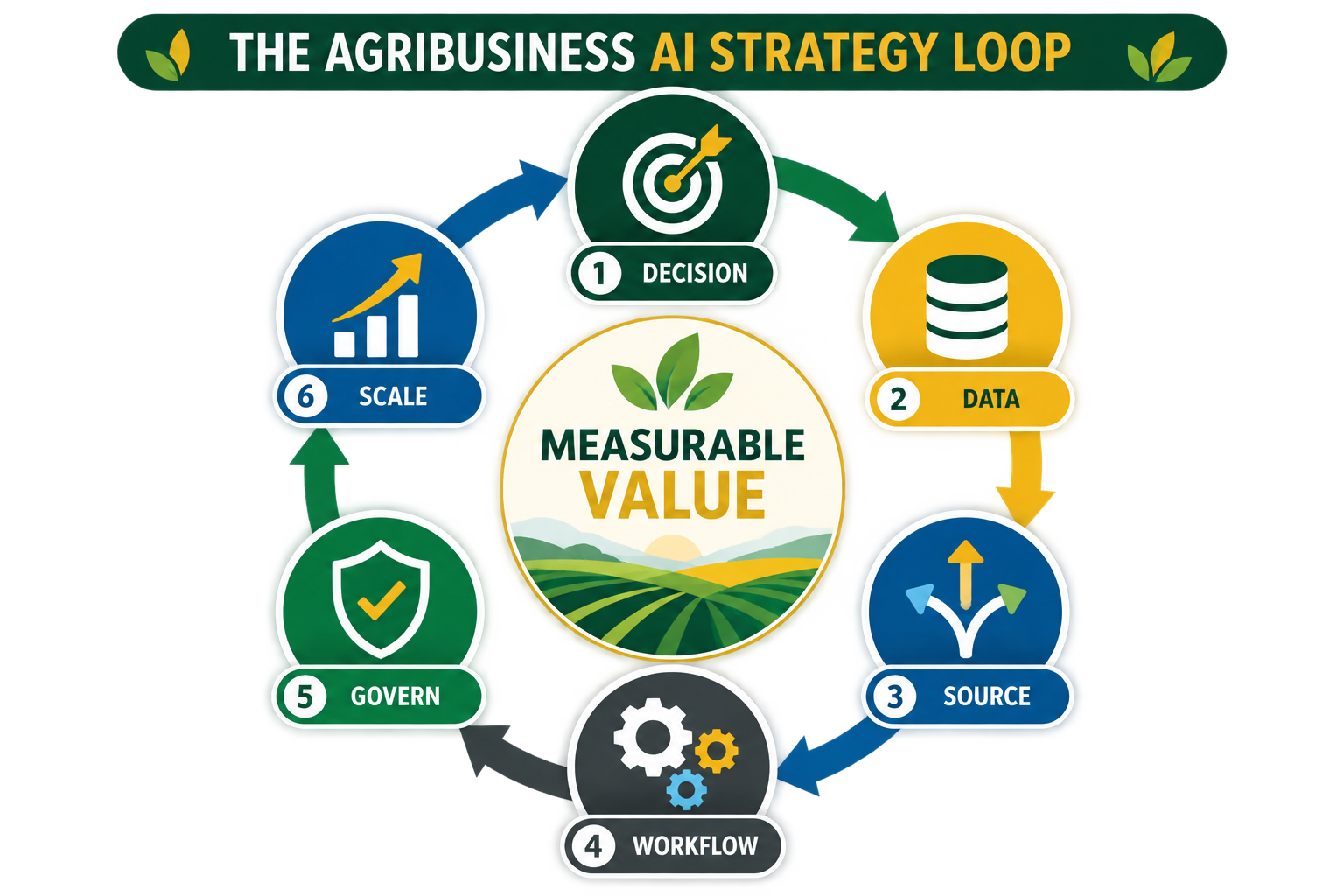
4. Fit an AI Strategy for Agribusiness into Workflows
A score has little value on its own. It must lead to an act.
For example, a spoilage alert should start a clear response. Staff may check the lot, move it, cool it, or send it for fast use. Then the team should record both the act and the result.
Domain experts are vital here. Data teams know how the model works. Yet buyers, crop experts, store teams, and field staff know what an error can cause. So they should help shape the tool from the start.
The plan should also state who reviews each alert. In addition, it should explain when a person may overrule the tool.
5. Govern an AI Strategy for Agribusiness
Risk work starts during design. It then stays active while the tool is in use.
The US National Institute of Standards and Technology groups this work into four tasks: govern, map, measure, and manage. The guide is free to use and fits many fields. See the NIST AI Risk Management Framework.
For each use case, ask:
- What harm can a wrong answer cause?
- Do we rely too much on one vendor or data source?
- Can a farmer, worker, or buyer question the result?
- Can the firm test, fix, and retire the tool?
The Food and Agriculture Organization takes a similar view. Its work calls for shared learning and good data care. It also stresses fairness, safety, and local needs. The Digital Agriculture and AI Innovation Roadmap explains this wider plan.
Governance needs named roles and routine review. Teams should document each system’s purpose, limits, data, evaluation method, and approval history. They should monitor accuracy after deployment because seasons and market behavior change. An escalation path must connect technical staff with business leaders and affected users.
Independent evaluation can strengthen this process. Periodic audits should test reliability, security, fairness, and human oversight under real operating conditions. The review should also confirm that the system still serves its original purpose and complies with current policy.
6. Scale with a road map
An AI strategy for agribusiness should link near-term work to long-term skill. Use three time frames:
- One year: Test a few sound use cases. Name each owner and measure.
- Three years: Put strong tools into daily work. Reuse data and rules.
- Five years: State how the new skill may change the firm’s path.
Review all projects as one set. For instance, buying, quality, and demand tools may need the same product data. A shared data layer can then serve all three. This may yield more value than one more stand-alone pilot.
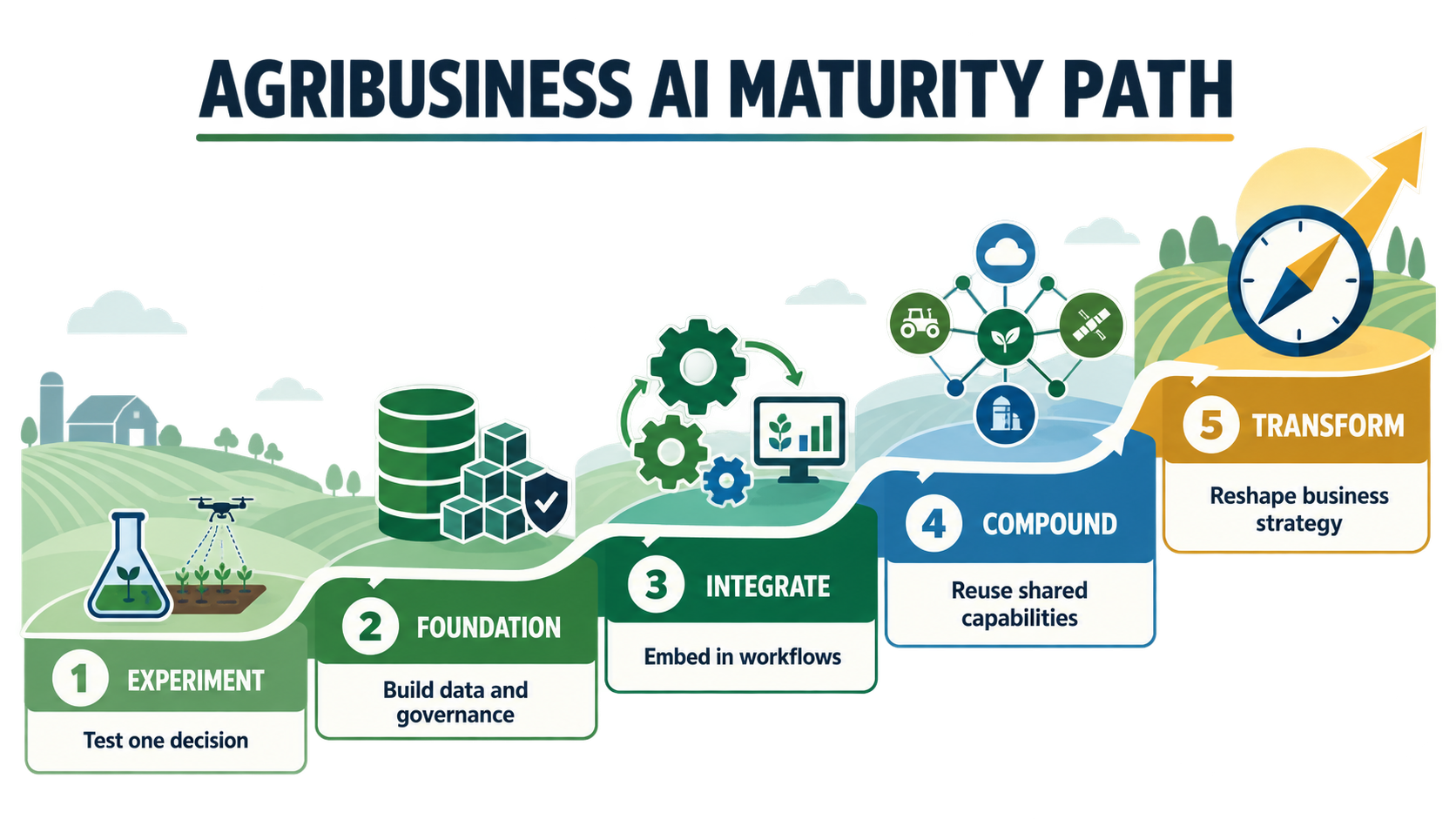
Use a Five-Stage AI Strategy for Agribusiness Maturity Check
The source book sets out five stages. They help leaders find the next gap:
- Experiment: The firm runs small tests with much vendor help.
- Foundation: Leaders fund data, staff, risk rules, and a road map.
- Integration: Teams use AI in real work across more than one unit.
- Compounding: New tools reuse shared data, rules, and skills.
- Transformation: AI skills change the firm’s products or business model.
One unit may sit at stage three while another sits at stage one. Therefore, the label matters less than the next gap. Leaders should ask what blocks the next step.
A 90-Day AI Strategy for Agribusiness Plan
An agribusiness can start with one firm work cycle.
In the first thirty days, form a small team. Pick three choices that recur. Then record the current steps, data, cost, and owner.
During days thirty-one to sixty, check the value and the data. Also, review the risk. Select one use case with a clear gain and a willing owner. Then choose whether to build, buy, share, or delay.
During days sixty-one to ninety, run a bounded test. Compare it with the old process. Set the rules for human review, alerts, and exit. Finally, judge the work process and the result.
For a field example, see How Drones Are Transforming Modern Agriculture. Also, explore the wider setting in 6 FAO Insights on Sustainable Food Systems.
The Strategic Test
A sound AI strategy for agribusiness answers five questions:
- Which choice will improve?
- How will we measure the gain?
- What data and work changes are needed?
- Who owns results, risk, and human review?
- What skill will remain after the project ends?
If the team cannot answer them, the idea needs more work. Start with one choice. Build the shared skill with care. Then let the results guide the next step.
AGTECH BRIEFING · A FUTURECENTRAL BRIEFING
Get practical agriculture intelligence in your inbox.
Focused analysis for people building, financing, and managing agriculture and food systems.
Free to subscribe. Confirm your email after signing up. Unsubscribe at any time.

